
How user segmentation, rather than personas, helps you get design buy-in
Businesses need to know who their user is, and how many there are


Photo by ELEVATE: https://www.pexels.com/photo/people-on-the-bar-drinking-and-conversing-3009803/
“Are we targeting this demographic because we want them to become repeat customers who spend X amount? That’s how you turn user understanding into market segmentation that justifies the investment.”
A design consultant told me this the other day, and it changed how I approach personas.
It’s not just about understanding who your users are. It’s about understanding how many of them there are.
That one element, scale, is often the difference between personas that collect dust and those that get your stakeholders’ attention.
More importantly, moving from user personas to user segmentation is a small shift that can make a significant difference in getting your team on board with user needs.
Why user personas get dismissed
It’s very likely that you have more than one type of user (and persona) at your organization.
Whether it’s admin vs non-admin or employee vs customer, you often design products that multiple user groups use.
If you create multiple personas to represent them, two questions immediately follow: Which user should be the primary user? And how big is each user group?
Take a typical set of users:
Beth, a mother of two who represents your core audience.
Alan, a seasonal shopper who makes large quarterly purchases.
Lydia, a power user who visits every week.
When all three exist side by side, does your team instinctively know that Beth represents 65% of your total audience?
That something convenient for Alan’s quarterly buying pattern actively works against Beth’s need to check out quickly?
That Beth’s time-sensitive needs belong to your most valuable segment?
Usually, we don’t communicate this, and that’s exactly what gets personas shelved.
Personas are the foundation. Segmentation makes them land.
User segmentation is a marketing approach used to understand users, and it’s often a perfect complement to user personas.
While personas might capture the qualitative picture of Beth, segmentation shows the more quantitative aspects:
Does she engage with social media or e-mail campaigns?
How long is she staying on the site?
How often does she buy?
The challenge is that these two views rarely talk to each other.
“I’ve seen teams with completely different segmentations. You’ve got a design team with a segmentation, a market research team with a segmentation, and they’re not the same. How can we be on the same page when we’re not even talking about the same people?” — Founder, Design consultancy
Having a full segmentation layer with a persona often requires coordination between teams. But adding a few segmentation elements to your personas can often make them much more persuasive.
Consider the difference between these two statements:
Beth is a 40-year-old mother of two who visits our site to purchase kid’s clothing while the kids are napping.
Beth, a 40-year-old mother of two, represents 65% of our total audience. She visits our site to purchase kids’ clothing while the kids are napping.
All we’ve added is a single additional data point. But by doing so, Beth isn’t just a character: she’s become a business case.
Here’s how to do that.
Four elements that turn personas into segments
Total audience size:
The simplest and most effective place to start. Whatever method you use, answer one question clearly: how many? You don’t need sophisticated analytics tools — a quick conversation with a PM is often enough.
How many customers do you have total?
How many fit this persona description? (i.e. “How many ‘seasonal buyers’ do we have, or ‘one-time purchase users’?)
(for prospective customers) What’s the total reach or potential audience for this initiative?
Whether something affects 5,000 people or 500,000 changes how seriously the team will prioritize it.
Time period:
“While the kids are napping” implies weekday afternoons, but we rarely make that explicit in personas, and we almost never extend it to seasonality.
Does Beth shop more in summer when her kids are at camp?
Identifying when she shops, from seasonal patterns to weekly use, can help us think about how we should design for her.
Device and tech context: Personas often flag tech literacy as “high” or “low,” but that framing is fuzzy.
What actually matters is: what is she using right now? If she’s shopping during naptime, is she on her phone because her laptop is in another room?
Is she pausing at certain points in the flow because she’s doing it one-handed? Device context makes the qualitative detail concrete.
New or returning customer: This one often appears in personas already, but it’s worth making explicit.
A first-time visitor and a loyal returning customer have different mental models, tolerances for friction, and expectations.
Their experience history should shape how you design for them.
Personas don’t need to be replaced. They need reinforcements
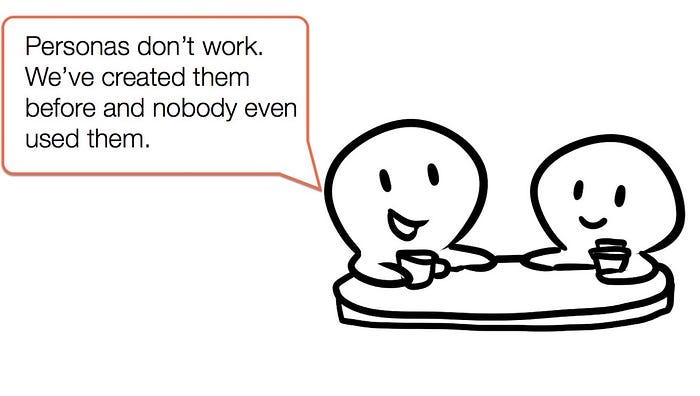
One of the worst outcomes for personas is that they become fictionalized artifacts no one finds relevant.
In fact, one of the most common reasons personas fail is a lack of buy-in from the business.
There are many ways to keep personas alive, but the most reliable one is helping people see how they connect to something the business already cares about: market size, revenue potential, customer retention.
User segmentation does that. It transforms something qualitative into something actionable. So if your personas are gathering dust, start there: even a single number can change how the room responds.
Kai Wong is a Design Educator and author of the Data and Design Newsletter. He teaches a course, Data Informed Design: How to Pitch Why Your Work Matters, on how to explain why your design work matters to businesses.